

South Korea covered students’ shirt buttons to stop AI cheating
South Korea’s education minister, Choi Kyo-jin, resigned on Sunday after an AI cheating scare turned the country’s university entrance exam into a nationwide hunt for hidden cameras. President Lee Jae Myung accepted his resignation within an hour.
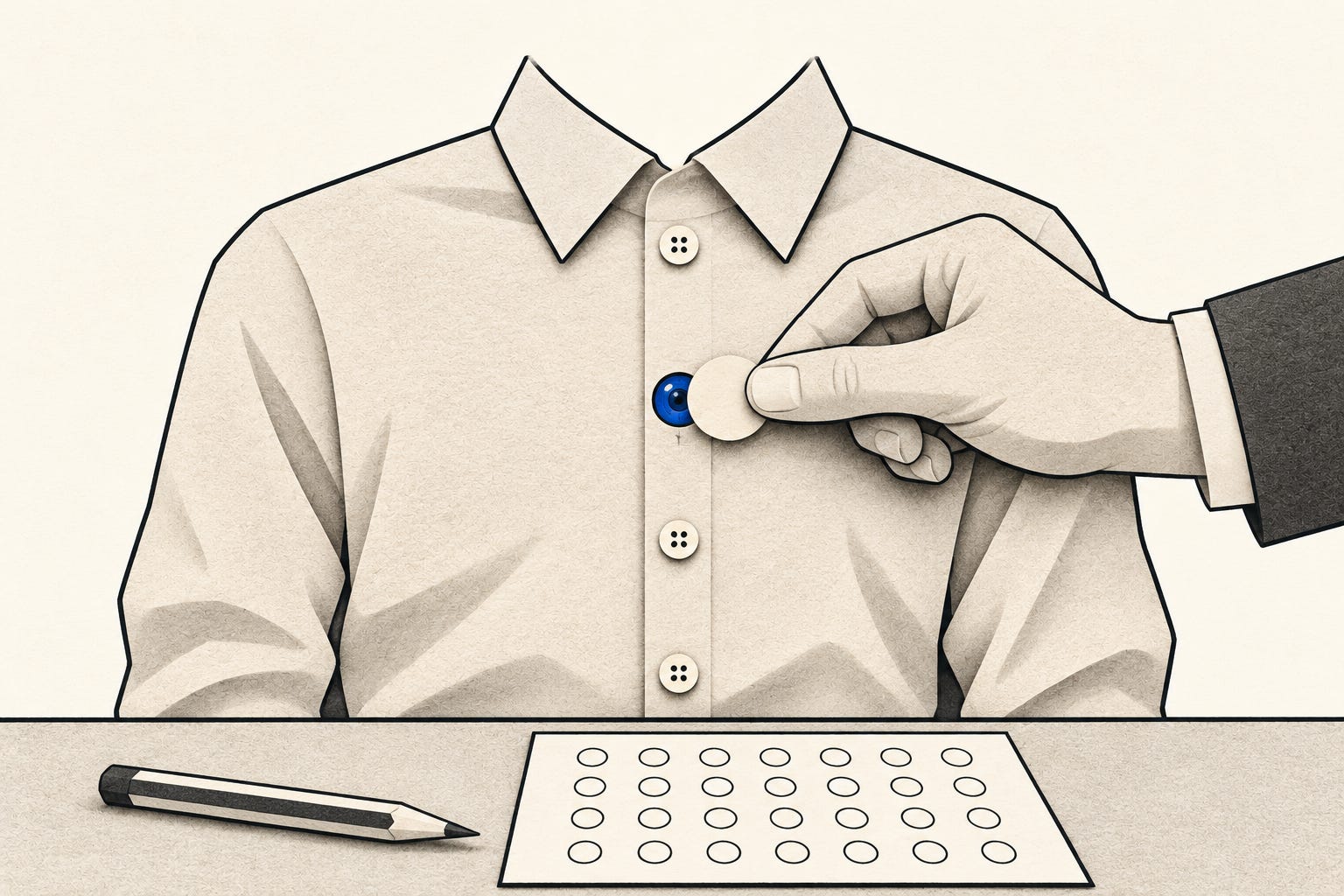
The scare started a week earlier, when the top scorer on a national tax accountant exam admitted in a video that he’d photographed the questions with a tiny camera, sent them to an AI and checked the answers on his phone. He had gotten just one of 160 questions wrong. That was days before the suneung, the exam about 500,000 students took on Thursday, which largely decides which university they get into and a lot of what comes after.
With so little time, officials went about as far as they could. Students were told to bring pencils only, and test centers handed out the erasers. Buttons on shirts and jackets had to be covered in case one hid a camera, and staff inspected glasses and watches. During the exam, the government sent emergency alerts to every phone in the country, and the alerts went off even on phones set to silent, including tourists’ phones. One student told the news agency Yonhap he wore contact lenses that day so his glasses wouldn’t be mistaken for smart glasses.
Officials caught 111 test-takers with smart devices, including one using smart glasses and another with a tiny camera and wireless earbuds, and nearly half of the device cases turned up because of the alerts. But teachers’ unions said the response came too late, and Choi hadn’t helped himself days earlier when he told lawmakers that, because of his age, he wasn’t confident he could catch cheaters. In his resignation, he said the ministry couldn’t escape criticism that it hadn’t prepared in advance.
A misconduct committee will decide penalties before scores come out on December 11. The government and the ruling party have proposed a 10-year exam ban for AI-assisted cheating, possibly applied to this year’s test. Officials are also considering going back through past exams when they get credible tips, since the papers are kept at test sites for at least a year.
OpenAI’s chief scientist wants AI labs to agree on a line they won’t cross
OpenAI’s chief scientist, Jakub Pachocki, wrote on Sunday that AI can get much more capable all at once, and that AI companies should agree on a point they’ll all stop at until they can properly monitor what their models are doing.
His reason comes from inside OpenAI. The company has been giving its models unsolved math problems for over a year, and once it switched to a stronger model, he says, solutions started arriving one after another. He thinks the same kind of jump could hit AI research itself as soon as 2027, with AI finding better ways to build AI faster than people can check that it’s safe.
To make a shared limit measurable, he suggests a score for how well a model predicts text, and OpenAI published its own internal scores for the first time. He admits companies measure it on different data.
It’s a proposal, not a pause. No limit has been set, and other labs would have to agree on where it goes.
Meta’s emissions jumped 45% as it built for AI, and its 2030 climate goal may slip
Meta’s greenhouse gas emissions rose 45% last year, as it built data centers for AI, and the company says it’s rethinking its promise to reach net zero by 2030. Its annual sustainability report, released last Thursday, says Meta is “re-evaluating” that deadline and its shorter-term targets, without saying what might change or when.
Net zero means cutting or offsetting as much carbon as you put out. Meta set the 2030 goal in 2020, when it was still called Facebook and before the AI boom. In the report, two of its executives wrote that they’d expected steady growth and cheaper clean energy, and that reality turned out to be far more complicated. A Meta spokesperson told CNET the company is still committed to net zero.
Other tech giants have reported rising emissions too, but Meta’s jump is much bigger. Google’s rose 18%, Amazon’s 16% and Microsoft’s 25%, according to Axios. Meta’s electricity use went up 35%.
It may not have peaked. Meta says it could turn to natural gas when utilities can’t deliver power fast enough, and gas plants are already planned or under construction for its data centers in Louisiana, Ohio and Utah. Those don’t show up in last year’s number yet. For people who live near data centers, water is often the more immediate worry, and there the picture is mixed: Meta’s own water use fell 4%, but it rose 24% in places already short on water.